
Switching From Recorder to Tin Whistle
Already play recorder? Here's exactly what transfers to tin whistle, what to unlearn, and the fastest way to use your recorder skills on a D whistle.
If you already play recorder, you're not starting from zero on the tin whistle: you're starting from about week three. The mouthpiece mechanics you already know, the basic idea of lifting fingers to climb a scale, and your reading of rhythm all carry over directly. What changes is which fingers do the lifting, what happens at the octave break, and almost everything about how you articulate a note.
What Transfers Immediately
Both instruments are fipple flutes: you blow into a mouthpiece that splits your air across an edge for you, so there's no embouchure to relearn and no new lip technique to build. If you can already produce a clean, steady tone on recorder, you can do the same on a tin whistle from the first breath.
The basic logic of the fingering also transfers. Both instruments use a lift-from-the-bottom approach for their natural scale: cover everything for the lowest note, lift fingers one at a time working upward to climb the scale. Your hands already understand this pattern; you're not learning a new concept, just a new specific layout to apply it to.
What's Gone: The Thumb Hole and Double Holes
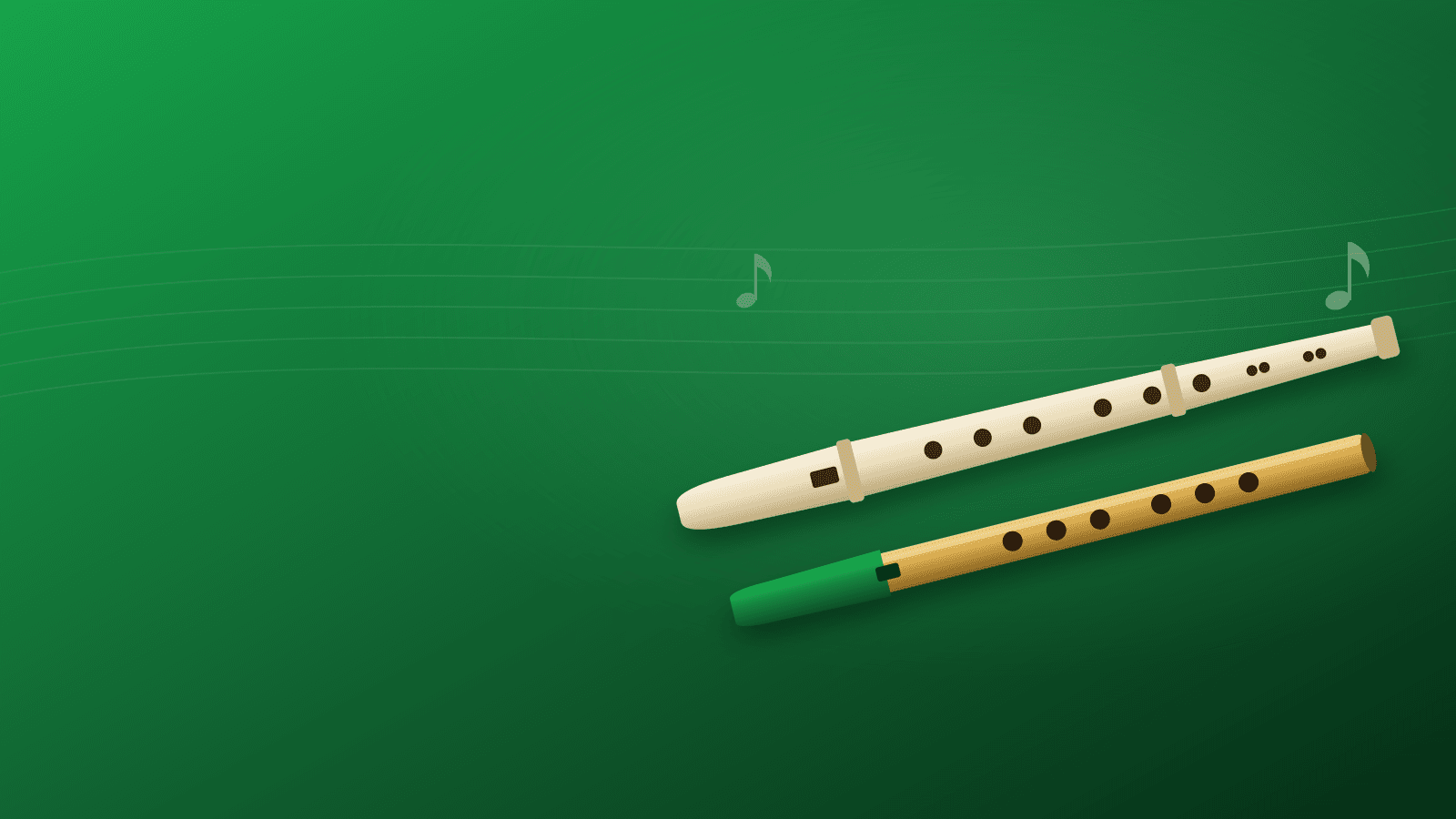
The biggest physical difference is what's missing. A soprano recorder has a thumb hole on the back, which you partially uncover to vent the instrument into its second octave, plus several finger holes split into double holes so a single finger can reach an in-between note. The tin whistle has neither. It's a simple front-only, single-hole-per-finger, six-hole layout, with your thumbs doing nothing but supporting the instrument's weight underneath.
The octave break works completely differently as a result. On recorder, you reach the second octave largely through that thumb vent, a specific mechanical action. On tin whistle, the octave is controlled almost entirely by air speed: the same six-hole fingerings you already use for the low octave repeat identically for the high octave, and you climb into it by blowing faster and more focused air rather than changing your fingers. The one common exception is the very top of the range, the second-octave tonic, which most players finger with the top hole vented rather than fully covered. Our guide on playing the second octave covers the mechanics and the common mistakes in full.
Learning D Major Instead of C Major
A soprano recorder's natural, no-cross-fingering scale is built around C major. A tin whistle's natural scale, with the same lift-from-the-bottom logic, is built around D major: D, E, F-sharp, G, A, B, C-sharp, and back to D. The shape of the pattern is identical to what you already know from recorder; only the starting pitch and the specific notes it lands on are different, since D major has two sharps built into its natural scale where C major has none.
This means two notes that were "free" on recorder, F natural and C natural, are not part of the whistle's easiest, natural fingering. They're still fully playable, just not automatic the way they were on recorder.
New Articulation: Cuts and Rolls Replace the Tongue
This is the change that surprises recorder players most. Recorder technique leans heavily on tonguing, a "tu" or "du" articulation at the front of the mouth, to start and separate notes cleanly, including fast single- and double-tonguing for quick passages. Traditional tin whistle playing mostly sets tonguing aside in favor of finger ornaments instead: cuts, taps, and rolls, made entirely with rapid finger movements rather than the tongue.
A cut is a fast flick of a finger above the sounding note, up and straight back down, so quick it registers as a click rather than a distinct pitch. A tap does the same thing with a finger below the note. Roll several together and you get the rhythmic, lilting drive that defines Irish traditional whistle style, doing the job your tongue used to do on recorder, but with a different, more percussive character. Our guide to tin whistle ornaments breaks these down step by step with the exact finger movements and the tests for whether you're doing them right.
You can still tongue notes on a tin whistle when it's musically appropriate, and nothing stops you from doing so. But if the bright, rhythmic Irish sound is what drew you to the instrument, learning cuts and taps rather than leaning on recorder-style tonguing habits is the fastest way to get there.
Breath Feels Different, Especially at the Top
Recorder tone, especially in the lower register, rewards a gentle, controlled airstream, and pushing too hard is a classic recorder squawk. Tin whistle breath asks for something slightly bolder, particularly to cleanly overblow into the second octave, where hesitant air tends to produce a weak, uncertain note rather than a clean one. If your recorder instincts are all about restraint, expect an adjustment period where you learn to commit more decisively to faster air for high notes while still keeping the low octave gentle. Our breathing and air control guide covers managing air differently across the two registers.
Reaching Accidentals Without Extra Holes
Without double holes or a thumb key, the tin whistle reaches notes outside its natural D major scale, like the C natural and F natural you took for granted on recorder, through half-holing and cross-fingering instead: partially covering a hole, or covering holes below an open one, to bend the pitch to where you need it. It takes more precision than a recorder's dedicated hole ever did, but it's a learnable, standard technique. How to play sharps and flats on tin whistle walks through exactly how to find C natural and F natural on a D whistle.
Your First Week on Whistle
Pick up a D whistle and don't reach for new repertoire yet: play something you already know cold on recorder, in its shape rather than its exact recorder fingering, and let your ear tell you when a note is right. Hot Cross Buns is about as simple a bridge tune as exists, using only three adjacent notes, so you can focus entirely on the new fingering rather than the melody. From there, Amazing Grace stays in a small, easy set of notes but reaches up into the second octave at its peak, a good low-pressure first test of the overblow. Once both feel comfortable, a genuine Irish tune like Star of the County Down will show you what the switch was actually for.
If you haven't yet decided between the two instruments and are still weighing which to learn first, our recorder vs tin whistle and tin whistle vs recorder vs Irish flute guides cover that decision directly; this piece assumes you've already made it and just want the fastest, cleanest transfer.
Questions Players Ask
Can I use recorder fingerings on a tin whistle?
Not directly. The lift-from-the-bottom logic is the same, but the tin whistle's natural scale is D major rather than C major, and it has no thumb hole or double holes, so several specific fingerings you know from recorder don't carry over unchanged.
Is tin whistle easier than recorder if I already play recorder?
In most practical ways, yes, especially at first: fewer holes to manage, no thumb key to coordinate, and a breath approach you've already built. The genuine new challenge isn't the mechanics, it's the ornamentation style, since Irish whistle playing leans on fingers rather than the tongue you're used to relying on.
Do I need to relearn breathing completely?
No, but you'll adjust it. Your existing breath control and phrasing sense transfer directly. What's different is committing to faster, more decisive air for the second octave rather than the gentler approach that suits a recorder's low register.
Will my recorder vibrato work on tin whistle?
If you learned diaphragm-based breath vibrato on recorder, yes, the mechanism is the same muscle action. Whistle players use it more sparingly, mostly on slow airs rather than fast dance tunes, but the technique itself transfers.